
3D rendering cost is the first question every developer, architect, and marketing lead asks — and the market’s answer looks like chaos. Published prices for a single exterior still start around $150 in Cad Crowd’s current guide and run to $3,200 in Omega Render’s 2026 band — and past $10,000 once MyArchitectAI reaches large commercial work. Both ends are real offers for something a buyer would call the same picture. We’ve been pricing visualization work for over a decade, and this guide does the thing the ranking cost guides don’t: instead of anchoring you to our own rate card, it reads across eleven pricing guides published between 2024 and 2026 — a mix of vendor rate cards, studio guides and broader market estimates, which is worth knowing, because not all of them are quoting their own work. Then it explains the part nobody publishes: why quotes for the same deliverable legitimately differ five-fold, ten-fold, sometimes more — and how to buy well inside that spread.
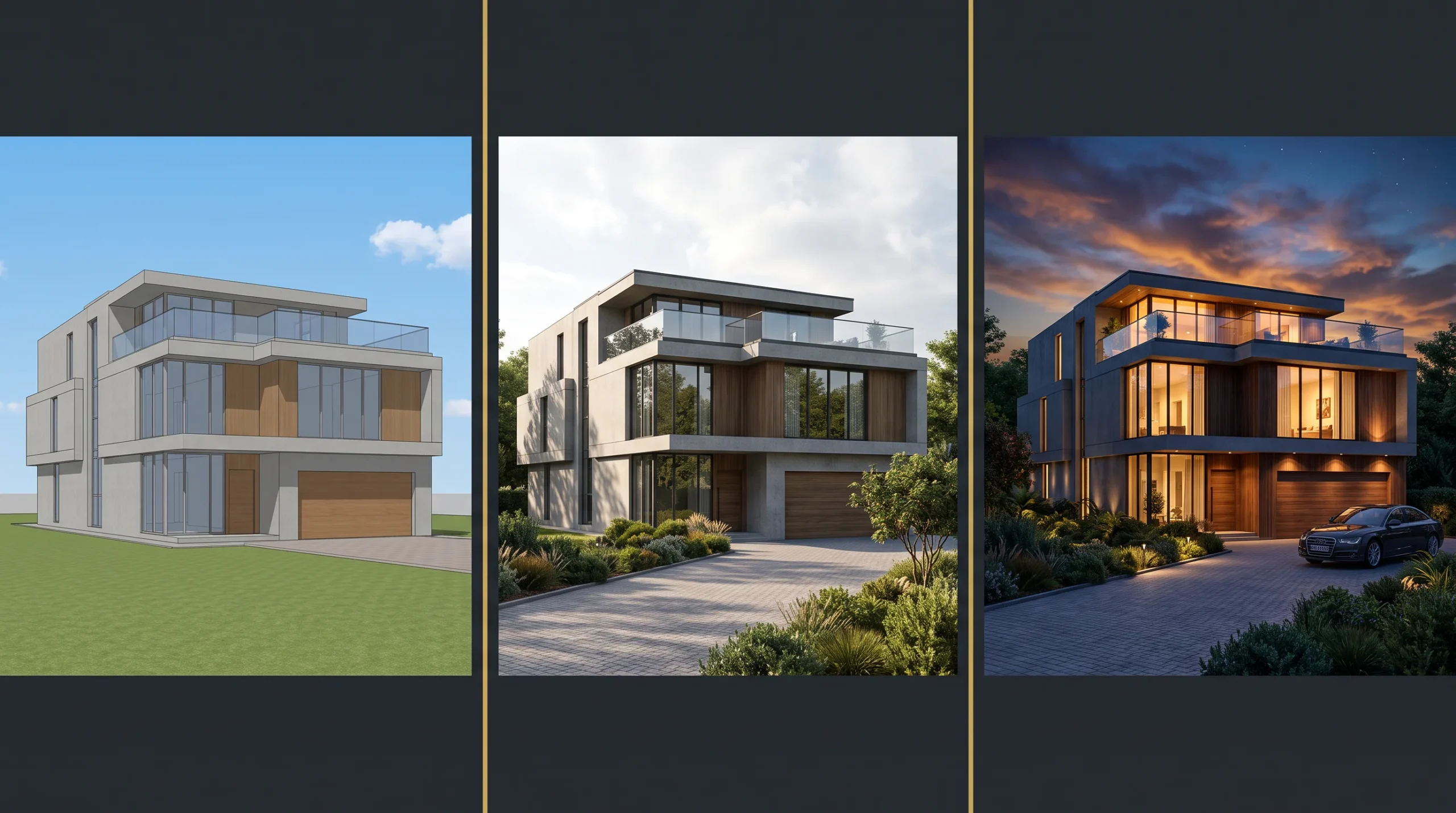
3D rendering cost by project type: the 2026 market ranges
The ten guides read for this are Omega Render, NoTriangle Studio, RealSpace3D, ArchiCGI, Maverick Frame, Cylind, Trim Render, Cad Crowd, MyArchitectAI and Render3DQuick, all published 2024–2026. Every figure below is checkable at those links. Some are rate cards for the publisher’s own work; MyArchitectAI presents figures it describes as industry averages drawn from more than thirty providers. Read the bands as the market’s shape, not as a survey and not as anyone’s price list.
| Deliverable | Typical market range | Floor / ceiling worth knowing |
|---|---|---|
| Exterior still | $500–$3,000 residential; $800–$5,000 commercial | Published floor around $150 (Cad Crowd); up to $10,000+ for large commercial (MyArchitectAI, 2026) |
| Interior still | Most studio work lands $600–$1,800 | Published floor $249 (Render3DQuick, 2026) — but note their interiors run $249–$1,000+, and the $2,500 edge belongs to exteriors |
| Aerial / masterplan | $800–$4,000 per view | Complex high-rise views $4,000–$8,000 per view (Maverick Frame, 2026). Note the unit changes for packages: the same guide prices a masterplanned-community house at $2,800–$4,500 for a three-view set |
| Animation | $2,500–$12,000 per finished minute | Marketing grade $8,000–$18,000/min (Maverick Frame) and $8,000–$15,000+ (Cylind); NoTriangle’s whole animation range tops out at $20,000+ |
| Single 360 panorama | $800–$2,500 per space | $800–$2,000 (MyArchitectAI); $1,500–$2,500 per space (Omega Render) |
| Connected multi-viewpoint tour | $1,600–$4,000+ per project | ArchiCGI’s published range; sparsest data of the six — treat quotes case by case |
Two patterns hold across almost every source. Interiors often price below comparable exteriors, especially at the entry end — Render3DQuick starts interiors at $249 against $499 for exteriors, roughly half. But it is a tendency, not a formula, and two of these guides break it outright: Cad Crowd currently lists interiors at $200–$6,000+ against exteriors at $150–$5,000+, and Omega’s interior band of $1,400–$2,600 sits inside its exterior band of $900–$3,200. Do not budget a standard interior discount. And rush deadlines carry a real surcharge: NoTriangle publishes 20–50%, Maverick Frame 30–50%, RealSpace3D 25–50%.
One row deserves its own warning. The 360 spread is wide because vendors sell different things under one name: the low end buys a rendered panorama of a single space, while the top of the range usually includes several connected viewpoints, tour assembly, and hosting. Watch for photography prices leaking into CGI comparisons, too — a Matterport scan of a house that already exists starts far below any of these, and it is not the same product. Before comparing two “virtual tour” quotes, make both vendors itemize viewpoints, stitching, and hosting. The cheap quote is often just fewer of all three.
Why quotes for the same render vary so widely
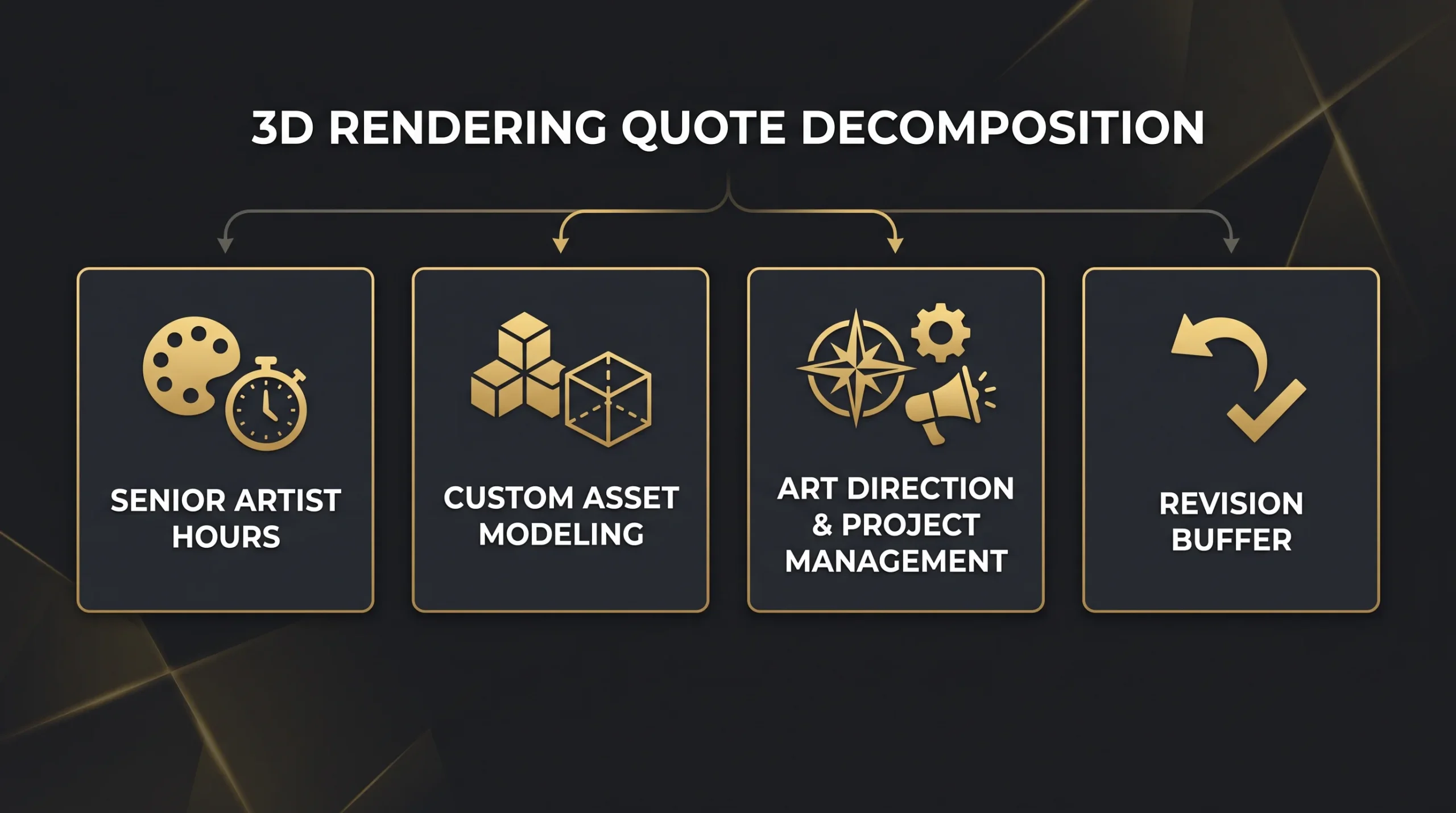
A $200 render and a $2,000 render — both prices sitting inside the published ranges above — are both real products. They are not the same product. The spread is structural, and it decomposes into parts no cost guide itemizes:
- Whose hours you’re buying. A junior generalist and a senior archviz artist produce images that photograph the same in a thumbnail and read completely differently to a buyer or planning committee.
- Library assets vs custom modeling. NoTriangle publishes custom-modeling add-ons at $25–$150 per item — a scene with your actual furniture package, signage, and landscaping is a different job than one dressed from a stock library.
- Art direction and project management. The invisible line item: someone deciding the camera, the light, the story of the image. At the lowest end this is often limited, or left largely to you.
- The revision buffer. Studio quotes price in the rounds they know are coming. Lower quotes may include fewer of them, or price later changes separately — compare the revision terms rather than assuming a buffer is in there.
- Accountability. A studio quote includes the cost of it being their problem when something’s wrong at 5pm before your investor meeting.
None of this makes the cheap option wrong. It makes it a specific product for a specific situation — early massing studies, internal reviews, low-stakes listings. The mistake is buying the floor price for a launch campaign and expecting ceiling-price outcomes.
The revision trap: where rendering budgets actually leak
Maverick Frame’s 2026 pricing guide says it plainly: revisions, not extra camera angles, are what drive project costs. RealSpace3D says most professional quotes include two to three revision rounds and then charge, pricing additional rounds at $100–$400 each — but almost nobody defines what one round means, and that ambiguity is where budgets go to die.
The pattern we see constantly: a project scoped for three rounds burns the first two on stakeholders who saw the image at different times. Round one collects the architect’s notes. Round two collects the developer’s. Round three belongs to the marketing lead, who has just joined the thread. Nobody planned a fourth round, and now it’s billable. The math scales badly from there: a six-image package reviewed by three stakeholders at different times isn’t three rounds of feedback, it can be nine, and every published per-round price assumes consolidated notes.
Two contractual questions to ask any studio before signing: what counts as one revision round (a consolidated list, or every email?), and what class of change is a revision versus a re-scope (moving a sofa is a revision; moving the sun, redesigning the facade, or adding a camera is not). Getting those answers in writing is worth more than negotiating 10% off the base price.
One model, three deliverables: sequencing is the real discount
The largest legitimate saving in this market isn’t haggling — it’s reuse. The big shared cost across visualization deliverables is building and approving the 3D scene, and the deliverables are downstream of it. That holds squarely for a multi-view still package; for a cinematic animation, camera work, animation, rendering and post can outweigh the base model. That’s why ArchiCGI says extra views of the same building cost less because they reuse one 3D scene — and publishes volume discounts reaching 40% on larger batches — while Trim Render’s exterior price falls from $700 for a single image to a $350 floor at volume.
Where the campaign allows it, sequence your orders to exploit that: stills first, since they force the model to be built and the materials approved, then animation off the approved model, then 360 panorama production from the same scenes. Split those three across three vendors, or order them in the wrong sequence, and you risk paying for substantial parts of the same model more than once — unless source files and handoff responsibilities are agreed up front.
Animation pricing: why “per minute” misleads
Animation is quoted per finished minute almost everywhere, and the unit hides two things. Minimum fees, first: a 15-second cut is nowhere near a quarter of a minute’s price, because the model, materials, and lighting cost the same regardless of runtime. Second, some vendors price per second instead — Trim Render publishes a flat $75 a second, which is $4,500 for a finished minute before anything project-specific — and per-second reads cheaper than it is once minimums apply. The tier-by-tier breakdown of what actually moves video pricing lives in our architectural animation cost breakdown; read that before you budget a number per minute.
What a quote-ready brief contains
ArchiCGI’s guidance puts it the way everyone in this industry does: a detailed brief with drawings, material samples and references means fewer assumptions, and fewer assumptions mean fewer revision rounds. Nobody publishes a hard number for it. But revisions are where the money goes, so the brief is where the saving is. If you want quotes that are both accurate and comparable, send every studio the same package:
- CAD, BIM, or dimensioned drawings — whatever exists, in its native format
- A material and finish schedule, even a rough one
- FF&E direction: actual product links or honest “designer’s choice”
- Camera count and angles, marked on a plan if possible
- Two or three reference images that show the mood you’re buying
- Resolution and usage: web listing, print billboard, or broadcast
- The real deadline, and the name of the single person who approves
That last line is the quiet one that matters. One approver per round is the cheapest schedule insurance there is.
Getting a real number for your project
Everything above comes from published pricing references, and it applies to us the same way it applies to everyone we’ve cited: your price depends on complexity, deliverables, sequencing, and how decisions get made on your side. We quote per project, after seeing drawings — the honest version of pricing in this industry. If you’re a developer or builder weighing what visualization is worth on a live project, how builders use visualization covers the return side of the equation this article priced.