
3D Visualization Services for Creative Agencies, Without the Brochure Speak
Most agencies don’t need a lecture on why 3D matters. You’re already pitching campaigns where the product doesn’t physically exist yet, the building won’t be finished for eighteen months, or the photoshoot would cost more than the entire production budget. The question isn’t whether to use CGI. The question is who builds it for you, on what schedule, and with how much hand-holding.

This page is for creative directors, producers, and account leads who plug external 3D studios into their workflow. It describes how we work with agencies as a production partner — what we deliver, where the boundaries sit, and how a typical job tends to play out. We’ve spent over 2 decades doing exactly this, often as the invisible CGI layer behind larger agencies’ deliverables.
Where Agency Work Sits in Our Studio
A meaningful share of our 1,500+ projects came through intermediary agencies rather than direct end-clients. Sometimes the end client is a global brand; sometimes it’s a regional developer; sometimes the agency itself doesn’t want us in the room. All of that is fine. We’re comfortable being the production resource that disappears into your deck, your reel, or your campaign site.
The studio is built around breadth: architectural visualization, product CGI, animation, and interactive web 3D — all under one roof. For agencies, that breadth matters because campaigns rarely need just one asset type. A property launch wants stills, a flythrough, a 360 tour, and a configurator on the microsite. Cobbling that together across three vendors is painful. One studio doing all of it is usually cheaper and always faster.
What We Actually Produce for Agencies
Below is the working menu. Pricing, scope, and turnaround are always project-specific — we’ll quote against a brief, not a rate card.
Product CGI for Advertising and Campaigns
This is the bread-and-butter agency request. You have a product that’s either (a) not yet manufactured, (b) impossible to photograph cleanly, or (c) needs to live in fifteen different hero environments without a fifteen-day photoshoot. Glass, liquids, cosmetics, perfume bottles, jewelry, packaged consumer goods, machinery, electronics — we model from references or a CAD file and render the hero shots, alt angles, exploded views, and lifestyle compositions you need.
The deliverables are usually PSD layered files (so the agency retoucher can adjust shadows, reflections, and background plates), high-resolution PNGs or TIFFs, and sometimes turntable animations for social. We work to a moodboard or a reference comp; if you need something built from a sketch on a napkin, we can do that too. More detail on our approach lives on the 3D product visualization service page.
Architectural Visualization for Real-Estate and Hospitality Campaigns
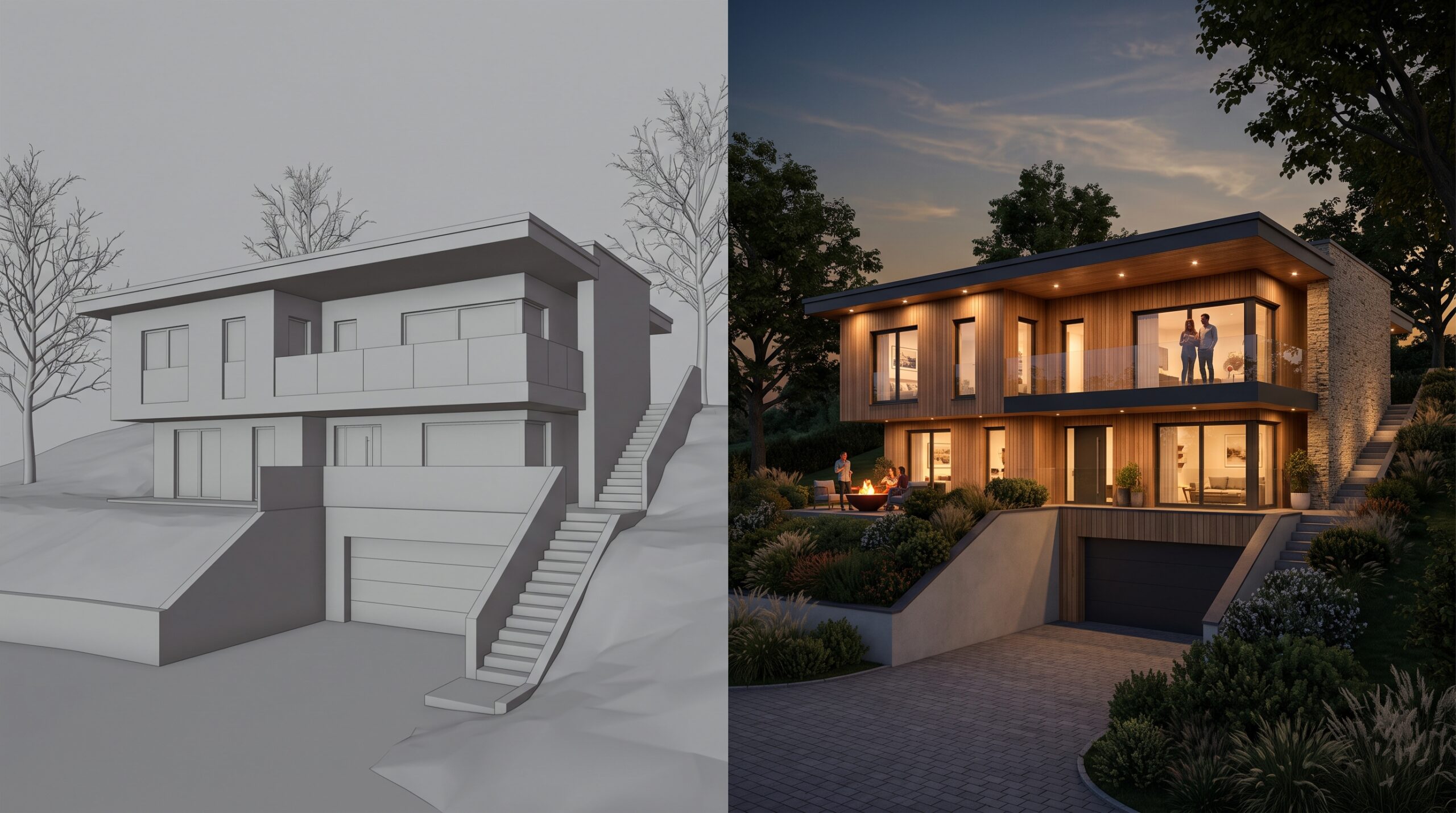
When an agency wins a property developer, a hospitality group, or a master-planned community, the visualization scope is usually substantial — exterior stills, interior stills, an aerial or master-plan render, sometimes a flythrough and a 360 tour. We work directly from the architect’s drawings (Revit, AutoCAD, PDFs, sometimes just sketches) and build the models, environments, and lighting. The agency typically owns the art direction; we own the production.
If you’re pitching a real-estate brand or already producing for one, our notes on visualization for property sales — including how the work supports off-plan campaigns — sit in our guide for real-estate agencies.
Animation and Motion Content
Architectural flythroughs, product explainer animations, manufacturing-process visualizations, mascot-style 3D character pieces, short ads that need a CGI element drop-in. We handle the full 3D side (modeling, animation, lighting, rendering, basic compositing) and hand off in whatever format your editor wants — usually high-bitrate ProRes or a render queue of frames, plus alphas and passes if your post house wants to comp themselves.
Interactive 3D for Microsites and Campaigns
This is where the studio quietly differentiates from a typical viz vendor. We build WebGL applications with Three.js — product configurators, material selectors, interactive showrooms, browser-based virtual environments. If a campaign brief includes “and the user can spin it and change the color on the site,” we don’t subcontract that out. It’s done in-house, often using the same models we built for the static renders.
Virtual Tours and 360 Panoramas
Either traditional pre-rendered 360 panoramas or game-engine-driven real-time walkthroughs, depending on what the campaign supports. For property launches and hospitality, real-time tends to win. For one-off pitches and pre-construction marketing, pre-rendered panoramas are usually plenty.

How We Slot Into an Agency’s Workflow
Most agency producers we work with want three things from a 3D vendor: a brief gets understood the first time, files land in usable formats, and someone picks up the phone when a client comment lands at 5pm.
- Briefs: we prefer something written, ideally with reference imagery, sketches, brand guidelines, and any CAD or 3D data you already have. A loose deck is fine; we’ll come back with questions before we start modeling.
- Reviews: we work in revision rounds. Typically clay/grey renders first (camera angles and composition locked before anyone fights about materials), then look-dev with lighting and materials, then final hero. Half the value of a clay render is that everyone shuts up about texture choices until the camera angle is locked.
- Files: agency-friendly outputs. Layered PSDs, alpha passes, render passes, source-file delivery on request, and sensible naming. We’ll match whatever your retoucher or motion editor prefers.
- Confidentiality: NDAs are routine. We don’t post agency work to our portfolio without explicit sign-off, and we don’t name end clients in published content. Several of our biggest projects aren’t on our public site at all.
What We Won’t Do, So You Can Plan Around It
Honest scope boundaries save everyone trouble.
- We don’t stamp engineering drawings or take engineer-of-record responsibility on architectural work.
- We don’t do structural, MEP, or load calculations. If a campaign needs that, your end client’s engineers will produce it; we’ll visualize from their drawings.
- We don’t pretend to be an “AI studio.” We use AI tools where they actually help — concept variations, look exploration, certain texture and matte-painting tasks — and we ignore them where they’d compromise the final pixel. If a brief specifically calls for an AI-driven pipeline, that’s a separate conversation.
- We’re not the world’s best at any single niche. We’re broad, fast, and very experienced across many disciplines. If your brief calls for the absolute top hero render in the world for a luxury car launch, there are boutique studios that specialize in only that. For everything else — the long tail of solid agency work — we’re a sensible partner.
A Note on Turnaround and Scale
Agencies usually ask two questions early: “How fast?” and “Can you handle the volume?” Both are project-specific. A single hero product render with a clean CAD file delivered as a layered PSD is a different timeline from a 60-second architectural flythrough with motion-tracked environment elements. We’ll quote against the brief.
On volume — we’ve delivered 3D model libraries running into the hundreds for online retailers, multi-asset campaign packages for international institutions, and ongoing render programs for developers who come back every quarter. Scale isn’t a surprise; that’s not a sales line, it’s literally how a 1,500+ project history accumulates.
If You’re Considering Us for an Active Brief
The fastest way to find out whether we’re a fit is to send the brief. We’ll respond with questions, an honest read on whether the scope sits inside our wheelhouse, and a quote against the spec. If the project is outside what we should be doing, we’ll say so — that happens occasionally, and it’s better for both sides than discovering it three weeks in.