
3D architectural animation is the part of a project package that finally makes a building feel like a place — not a stack of drawings, not a set of stills, but a camera moving through space the way a future buyer or tenant would. We build these videos for developers selling off-plan units, builders pitching schemes to investors, and architects who need a board to see the design the way the design team already sees it.
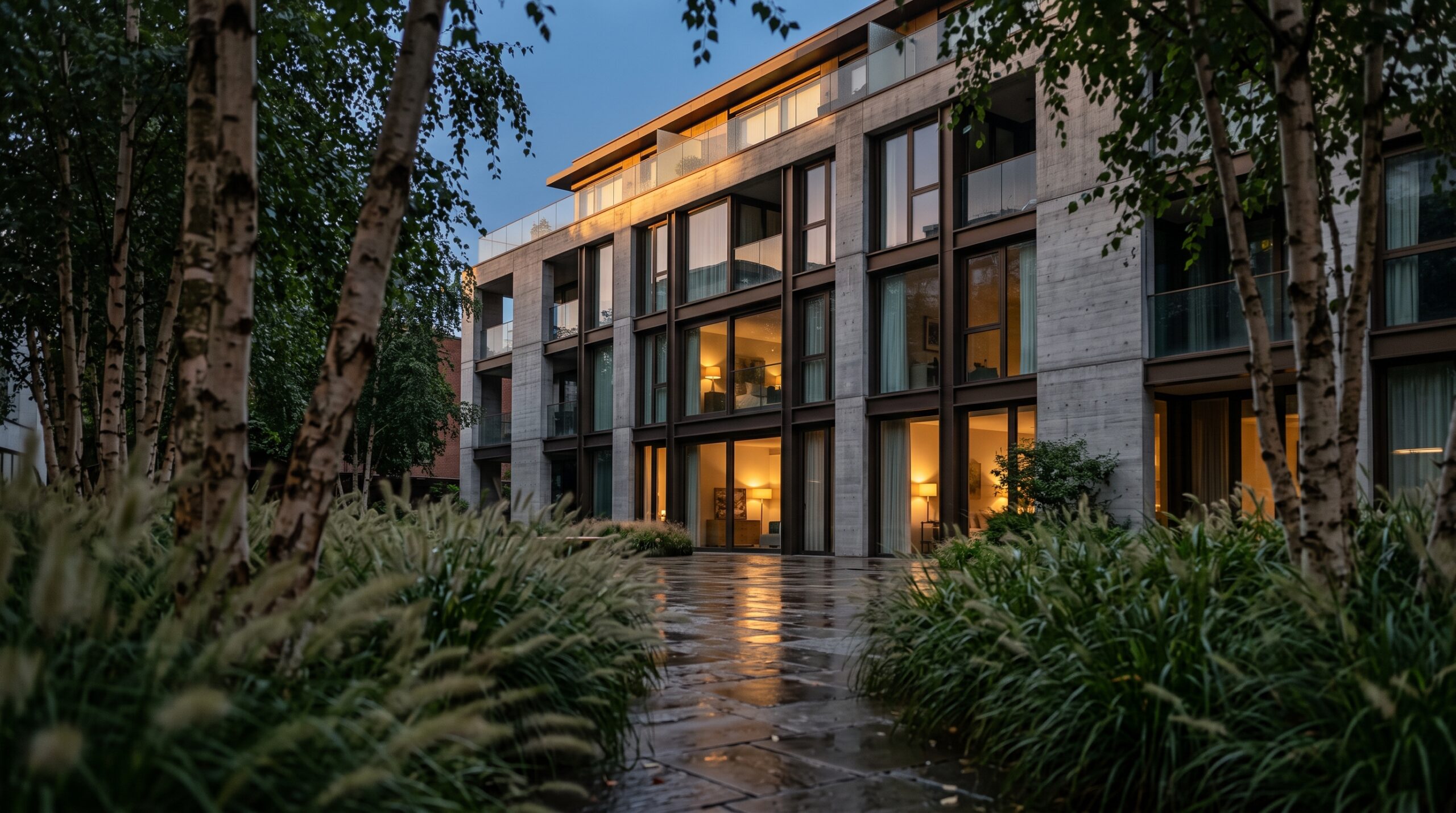
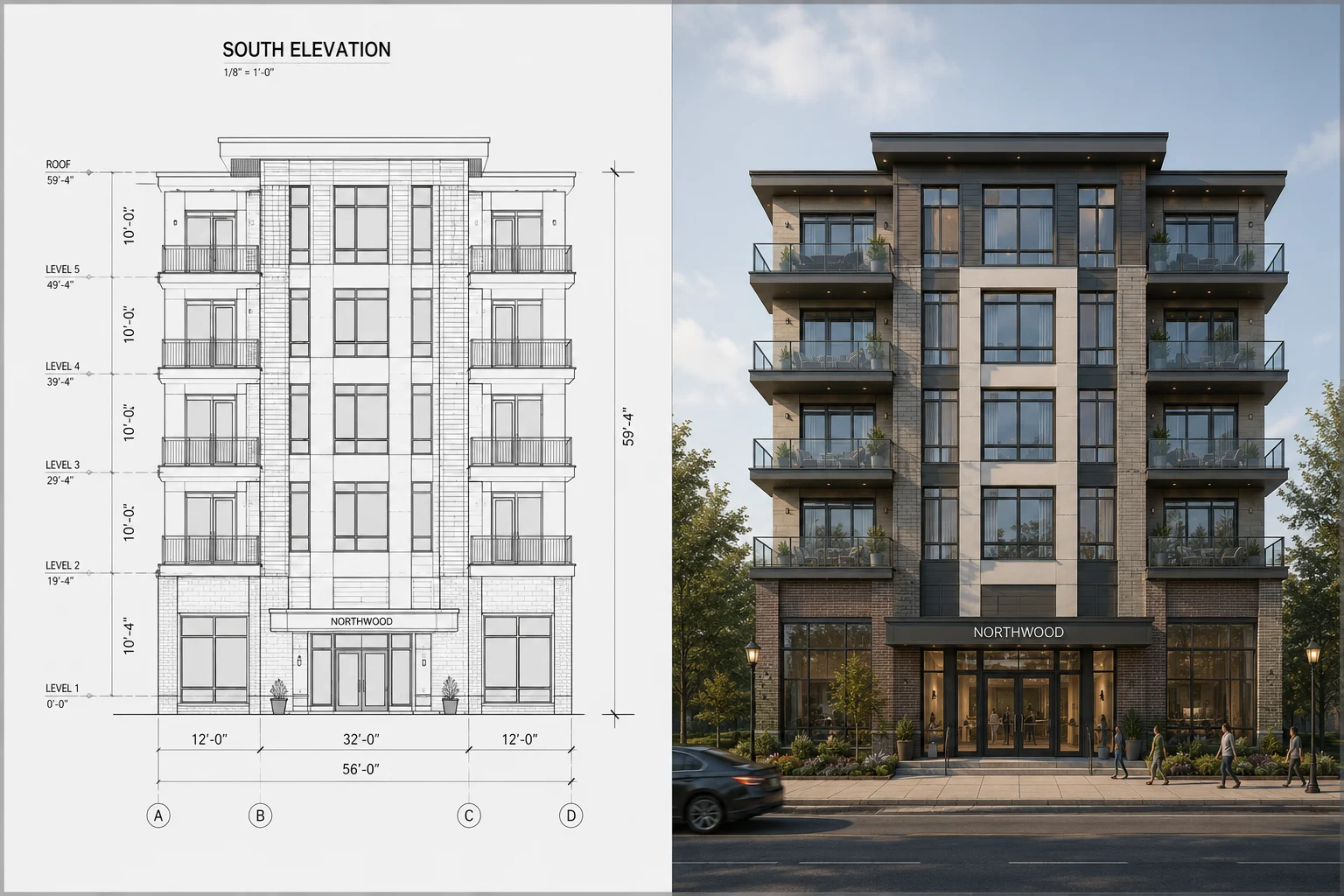
Most architectural drawings ask the viewer to do a lot of mental assembly. Sections, elevations, plans — they are precise, and they are professional. They are also opaque to anyone who isn’t trained to read them. A 90-second flythrough does in a minute what a printed package cannot do at all: it tells a non-technical audience what it will be like to stand on that corner, walk through that lobby, look down that hallway. That is the entire job.
What we deliver under “3D architectural animation”
The phrase covers a range of outputs, and the right one depends on who the audience is and what they’re being asked to do.
- Cinematic exterior flythroughs. Aerial-style camera work over and around a building or masterplan. Used most often for sales sites, leasing brochures, investor pitches, and planning hearings.
- Interior walkthroughs. First-person camera moving through lobbies, apartments, amenities, retail floors, restaurants. Slower pacing, closer attention to materials and light.
- Marketing spots. Shorter cuts — 15 to 60 seconds — built for social, paid ads, and homepage hero loops. Different rules: faster cuts, cleaner messaging, often no narration.
- Construction sequence animations. Time-lapse-style buildouts showing how a project assembles. Useful for technical presentations and for explaining phasing to non-construction audiences.
- 360-degree video and panoramic tours. Where the audience controls the view direction. Useful at trade shows, on VR headsets, and embedded in property listings.
- Real-time walkthroughs. Game-engine builds where the viewer drives the camera themselves. Heavier lift, but the right answer when you want a developer or investor to actually explore the property rather than watch a fixed video. See our 3D animation hub for how this fits alongside other animation deliverables.
Not every project needs all of these. Half the conversations we have at the start of a job are about trimming the brief down to what actually moves the needle.
The toolchain (and why it matters)
We model and animate in 3ds Max, render with Corona, and finish in After Effects and Premiere. For real-time deliverables we move into game-engine pipelines. None of this is exotic — it’s the same stack a lot of competent studios use — but it matters because it shapes what we can hand off, how revisions get priced, and how quickly we can iterate when something changes upstream.
Two practical consequences worth flagging up front. First, photoreal materials and lighting take time; a single architectural shot is not the same animal as a generic motion-graphics clip. Second, once a camera path is locked and rendering has started, big creative changes get expensive fast. Good briefs lock the storyboard first. Sloppy briefs discover what they wanted halfway through render. We’d rather have the awkward conversation early.
Our process for a typical 3D architectural animation job
The shape is roughly the same whether it’s a 30-second marketing spot or a four-minute flythrough of a mixed-use development.
- Brief and scope. Who’s the audience, what do they need to do or feel after watching, what’s the duration, what’s the delivery channel. Without these, everything downstream is a guess.
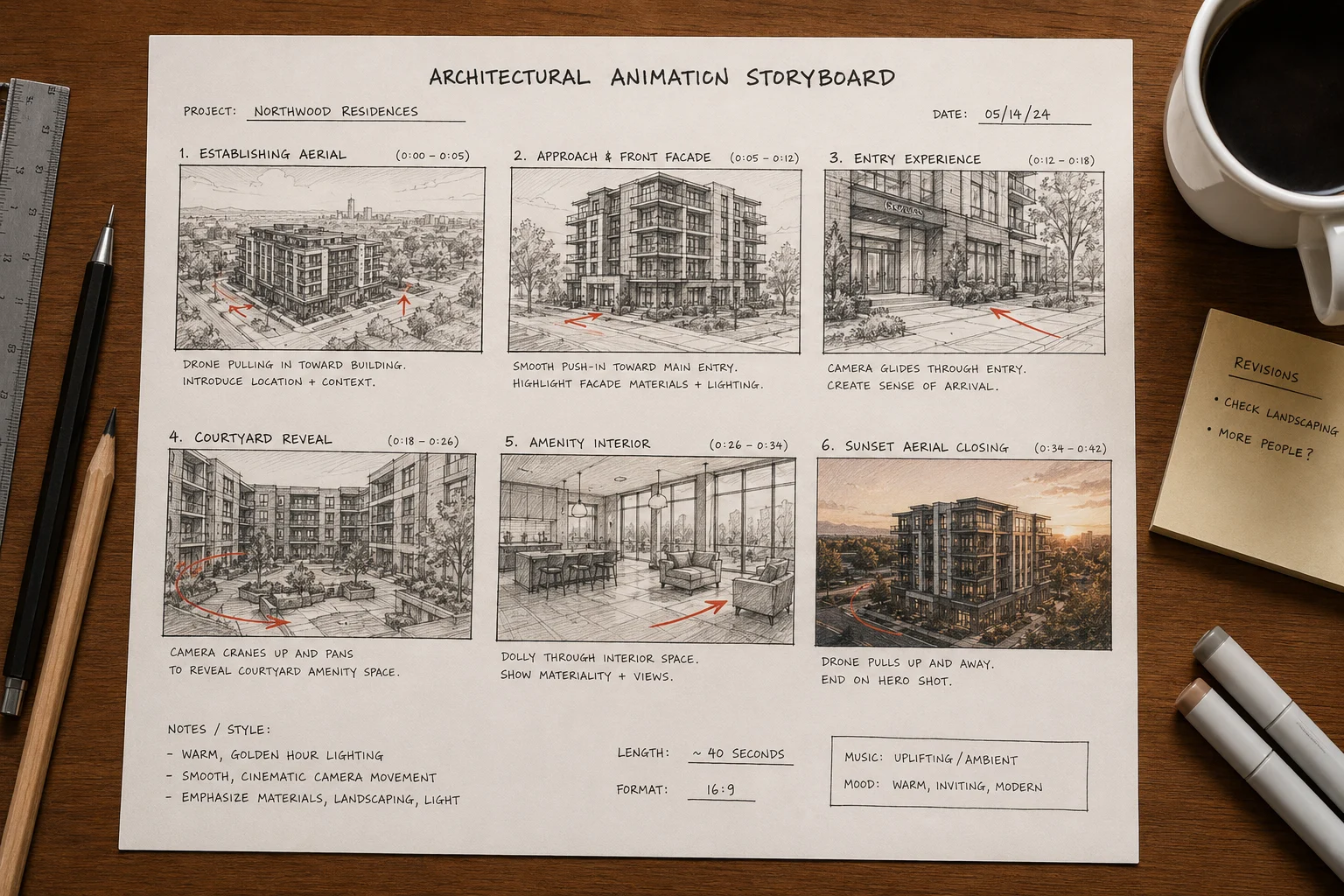
- Storyboard. Camera positions, key beats, on-screen messaging if any, music tone. We sign this off before we touch geometry.
- Animatic. A low-res pass with simplified geometry showing camera moves and timing. This is where most of the real creative decisions get made. It is also where most last-minute reroutes happen — which is fine. That’s what the animatic is for.
- Modeling and texturing. Either built from the architect’s CAD/Revit files (preferred) or modeled to scale from drawing packages. Materials are matched against samples or specs.
- Lighting and rendering. The longest part of the job in wall-clock terms. Each frame at 4K with photoreal materials takes real time.
- Compositing and edit. Color, atmosphere, music, sound design where required, on-screen titles, voiceover if any.
- Review rounds. Built into the schedule, not bolted on after delivery.
Real projects do not move through this in a straight line. Drawings change. The marketing team decides they want a different opening shot. A new amenity gets added. We plan for it.
Who tends to hire us for this
The audience for an architectural animation isn’t always the same as the audience for the building itself, and that distinction shapes the brief.
- Residential developers selling off-plan condos and houses. Pre-sales need something better than a brochure. A walkthrough closes the imagination gap that floor plans cannot — and on premium product, the same gap is the reason buyers hesitate.
- Commercial and mixed-use developers presenting to anchor tenants, lenders, and city councils. Different rooms, different decisions, but the same need to make an unbuilt thing legible to non-specialists in a 20-minute meeting.
- Builders and construction firms who want a single asset they can show in pitches without dragging a project’s design team into every conversation. We’ve gone deeper into this audience on our builders’ services page.
- Architects presenting concept-stage and design-development work to clients and review boards. A short animation often wins approval rounds that a static board cannot — and it gives the architect a tool the client can forward to their own stakeholders.
- Real estate teams and brokerages marketing properties before they’re complete, or staging high-value listings that aren’t yet built. There’s more on this audience on our real estate page.
- Hospitality and retail operators launching new locations or rebrands. The animation often runs as a 30-second loop in the lobby of the corporate office before it ever sees a customer.
Where animation is the right tool — and where it isn’t
For a developer pitching off-plan apartments, a walkthrough animation often answers questions that a drawing package cannot. Investors don’t decode elevations and sections in their spare time. We’ve watched projects lose momentum just because nobody outside the design team could read the drawings. A two-minute video usually fixes that overnight.
For a single-unit interior remodel for a homeowner, animation is usually overkill. A handful of still renderings — fewer hours, lower cost, the same emotional payoff — does the job. We will say so. Pushing a client into an animation when the project doesn’t need one is a fast way to deliver something the client doesn’t actually use.
What animation does not solve
A few things to be honest about. Animation is a presentation layer. It will not save a weak design, it will not paper over an unresolved program, and it will not substitute for the engineering and construction documentation a real project needs. We have seen clients hope that a beautiful 90-second video will fix doubts a board has about the scheme itself. It won’t. The video makes the design legible; the design still has to be good.
It is also not a substitute for stamped engineering or for the technical drawings a contractor needs. We are a visualization studio. We work alongside the engineers and the architects of record; we do not replace them. Our preliminary drafting work — described on our architectural design page — supports licensed professionals; it does not stand in for them.
And there’s the question of timeline. Photoreal animation is slow by nature. A serious flythrough is not a two-day turnaround. Marketing teams who book the campaign date before they book the production date end up regretting it. We bring this up early because the alternative is bringing it up late.
Why hire us for it
Over 2 decades of project work and 1,500+ projects across many client types means most of the situations a developer or architect can throw at us are familiar. We’ve animated single-family homes, residential complexes, hospitality projects, retail, mixed-use, masterplans, and a long list of one-off jobs that don’t fit any tidy category. We’ve also built the WebGL and real-time walkthrough side of the business — so when a project calls for an interactive layer on top of the cinematic, that work doesn’t need a second studio.
We aren’t the world’s best at any single niche. What we offer is breadth, a body of work to back it up, and a willingness to tell a client when an animation isn’t what they actually need. Some studios won’t say that. We will.