
Most designers we work with do not need a sales pitch about why 3D matters. They need a production partner who can take a layout, a mood board and a few cabinetry sketches and turn them into images their client will actually approve. That is the entire job, and it is what our 3D visualization services for designers are built around — quiet execution behind your brand, on your timeline, in your style.
This page explains how we plug into a designer-led project: what we deliver, how the handoff usually works, what to send us, and where the predictable friction lives. No mystery boxes.
What 3D visualization services for designers actually cover
Designers come to us with a mix of work, but the patterns repeat. The studio sits behind your practice and produces the visual content you would otherwise hand to a junior, an outsourced freelancer, or — more often — push to the bottom of your own task list at midnight.
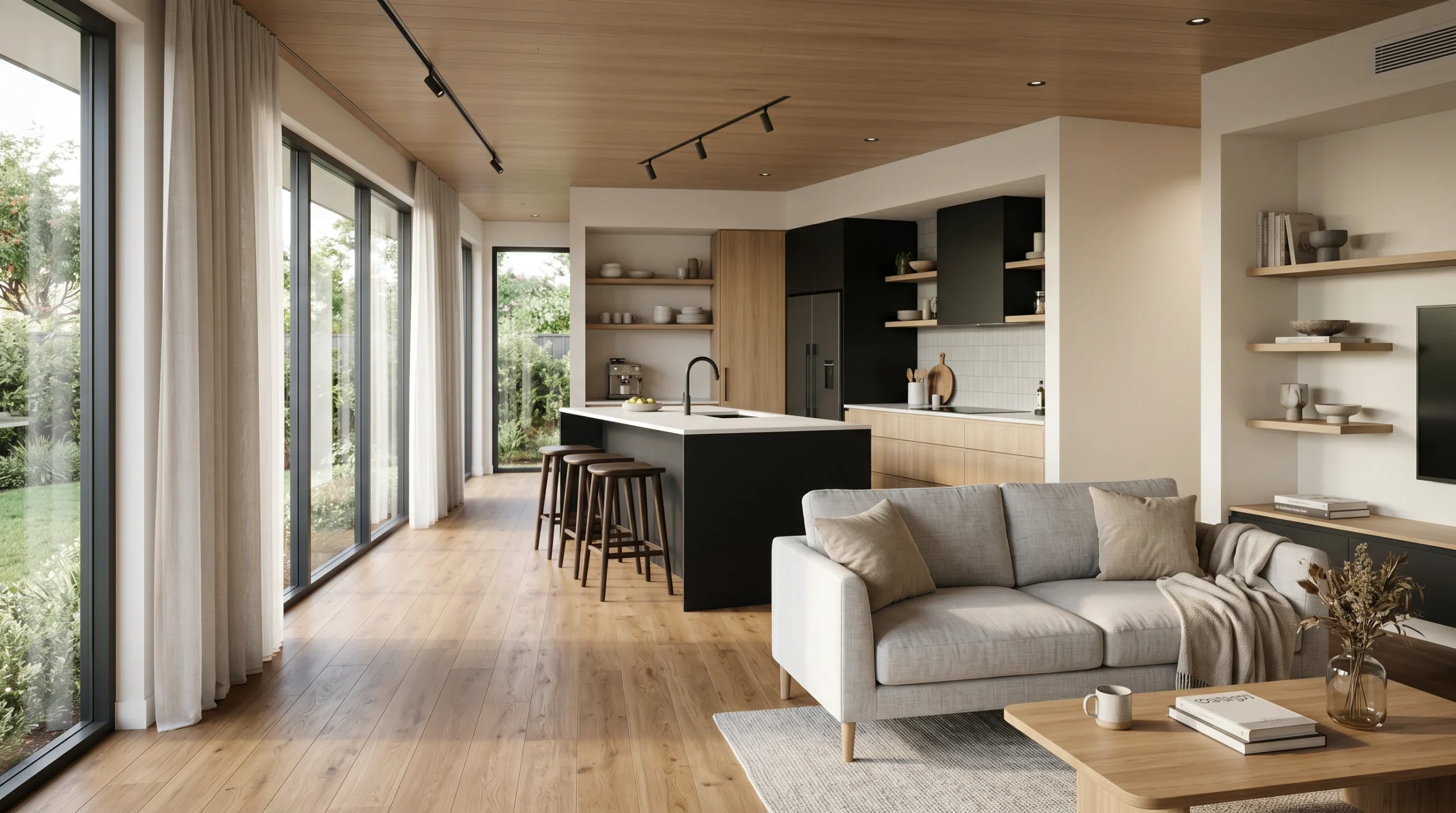
- Interior renderings — residential rooms, kitchens, bathrooms, whole-home concepts, hospitality and retail interiors. Photoreal stills aimed at client approval, not portfolio fluff.
- Exterior renderings — single residences, villas, small multi-family, commercial facades, landscape context shots to back up an interior pitch.
- Walkthrough animations — short cinematic flythroughs and room-to-room walks. Useful when a still image cannot carry a complex space, or when a developer client wants something to show investors.
- 360 panoramic tours — interactive panoramas the homeowner or end buyer can scroll through on a phone. Often the cheapest way to make a client feel inside a space.
- Product and furniture visuals — one-off objects (a custom fireplace, a built-in bar, a signature piece of furniture) rendered against a clean background or dropped into the room.
- Material and finish studies — same camera, different floor / countertop / paint. The fastest way to settle the seven-finish argument with a client.
What we do not do, and will tell you up front: we are not a stamped-drawing shop. We do not sign off on structural, MEP or permit drawings, and we do not produce licensed landscape architecture documents. If you need that work, you need an engineer of record. We sit on the visualization side of your stack.
How the designer-led workflow actually runs
The pattern that works best — and the one most of our designer clients eventually settle into — keeps the studio invisible to the end client. You own the relationship, the design decisions, the presentation. We own the geometry, the lighting, the renders, the revisions to those renders. Nothing gets sent direct to your client without your sign-off.
A typical sequence looks like this:
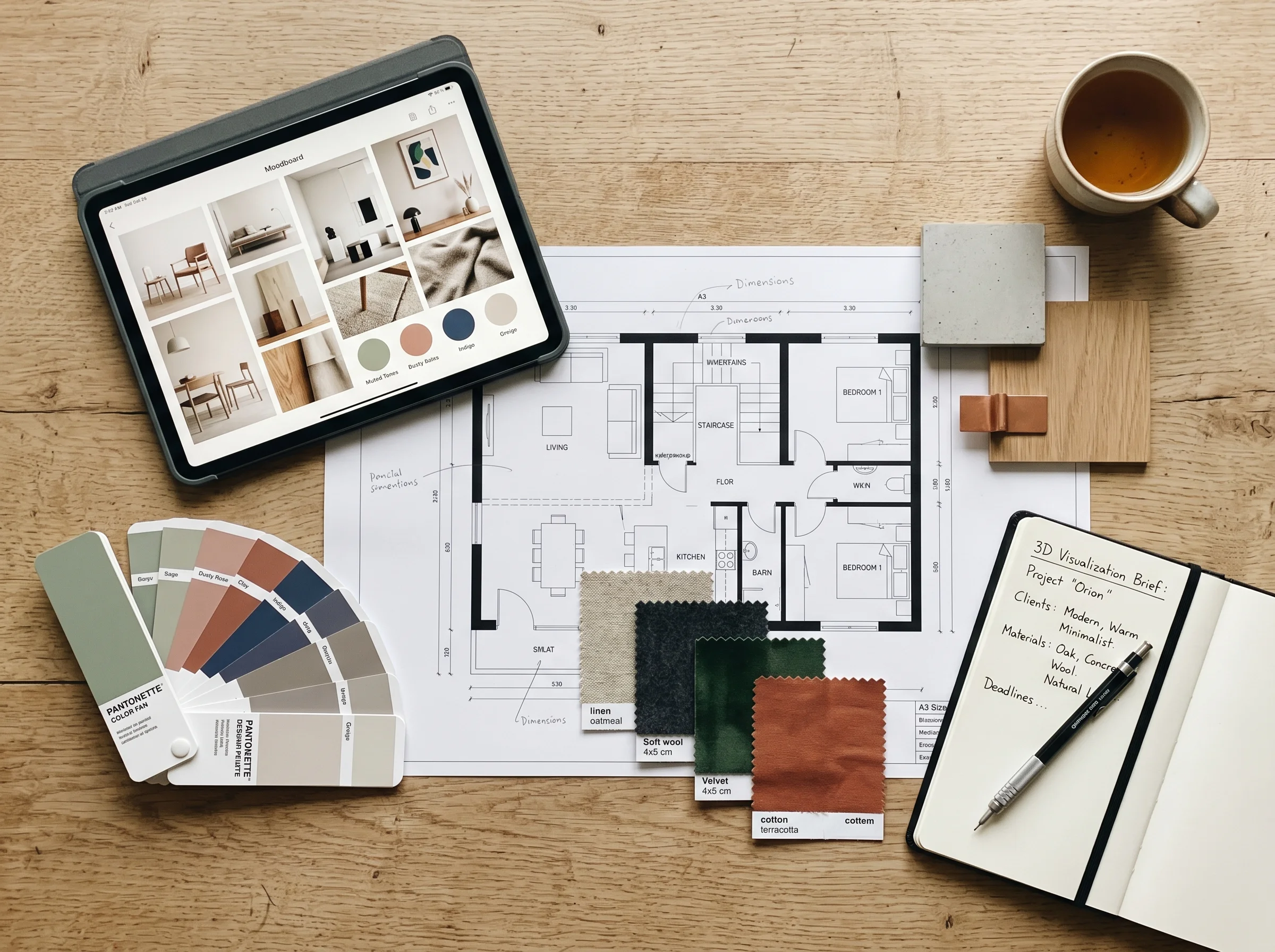
- Brief and references. You send us your floor plan or sketch, a moodboard or some reference shots, a rough list of materials, and the camera angles you want hit. Doesn’t have to be polished — we have read worse.
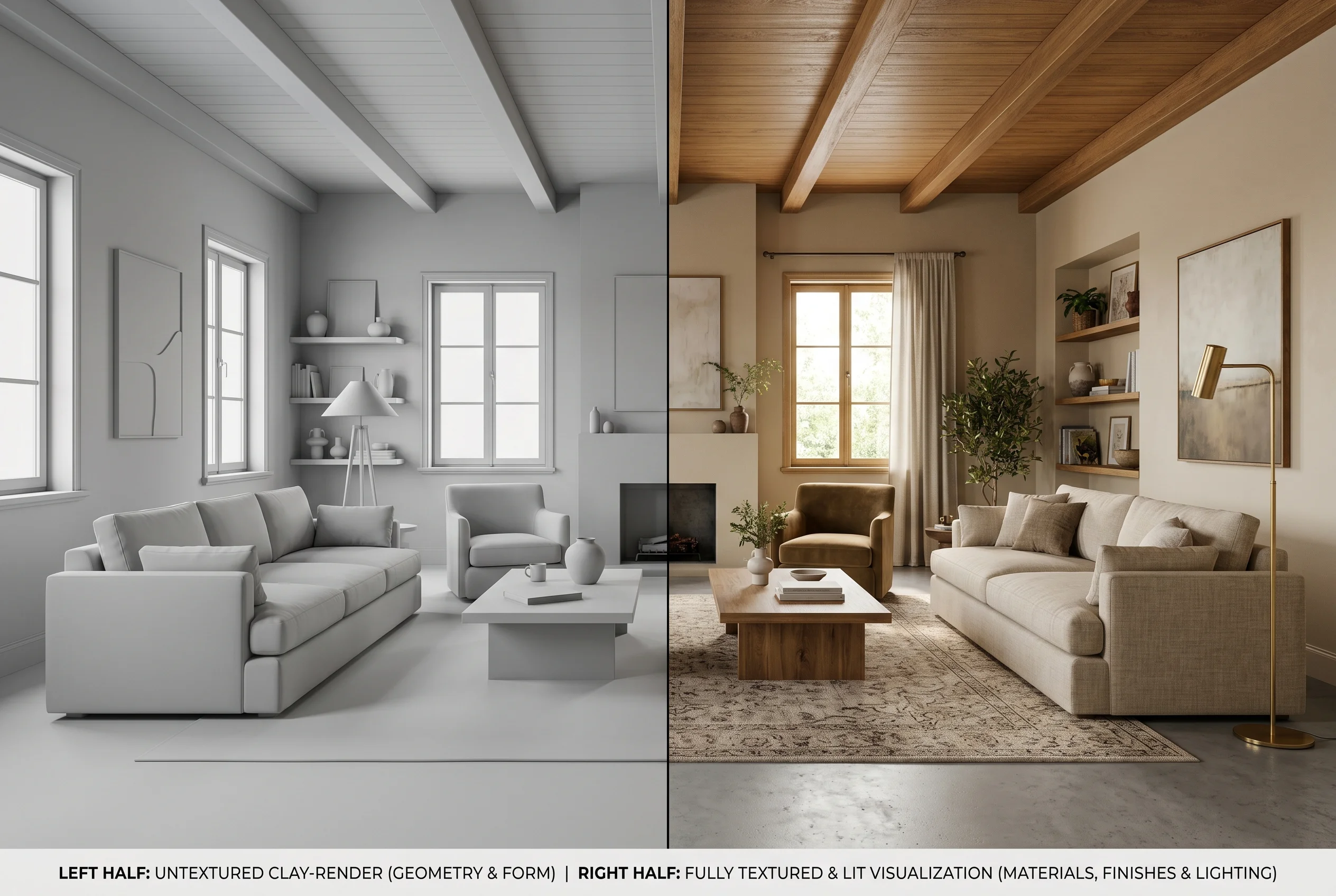
- Modeling and grey-box. We build the geometry and send you flat clay renders so you can lock the camera angles and the composition before anyone argues about a sofa.
- Materials and lighting. Finishes go in, lights are placed, the scene starts to look like a render. This is where most revisions live.
- Client preview. You take the WIP images, present them under your own brand, gather feedback. We do not see your client unless you want us to.
- Final renders. Approved frames go to full resolution, get any required post in Photoshop or After Effects, and ship as PNG, JPG, MP4 or interactive panorama — whatever the deliverable was.
Half the value of a clay-render pass is that everyone shuts up about texture choices until the camera angle is locked. It sounds petty. It saves projects.
What to send us when you brief the job
The smoother the brief, the fewer rounds we burn on revisions. We have done this with napkin sketches and we have done it with a full Revit model. Both work. But the more you give, the less we have to guess.
- Floor plan in DWG, PDF or even a clean photo of a hand sketch.
- Elevations or section drawings if exterior is involved.
- A material list — even informal. Brand names, finish codes, or just “matte black metal, oak floor, warm white walls” works.
- Reference images. Mood, lighting feel, anything close to the look you want. Pinterest boards are fine.
- Camera direction. Either marked on the plan or described — “kitchen looking toward the island”, “facade from the street, slightly low angle”.
- Final deliverable spec. Print resolution, web only, animation length, panorama for an iframe — say what the file is for.
If you do not have all of this, we will fill the gaps and check back with you. We do not need a perfect package to start. We do need to know what the client is approving against.
Tools, formats and what ships
The studio is built on 3ds Max and Corona Renderer for stills, with Revit on the drafting side when designers come to us with a BIM model. Animation work runs through 3ds Max plus After Effects and Premiere for post. For interactive panoramas and lightweight in-browser 3D we use Three.js. Material and image polish is done in Photoshop. Nothing exotic — boring, mature pipelines that produce predictable results, which is what you want when your client is waiting.
Standard deliverables for a designer-fronted job:
- Stills: JPG or PNG at print resolution, plus a smaller web-ready copy. Layered PSD on request when you want to swap finishes downstream.
- Animation: MP4 in 1080p or 4K, with the option of a clean master and a captioned client version.
- 360 panoramas: stitched equirectangular images plus an embeddable viewer link or HTML package you can host yourself.
- Source files: handed over by arrangement at the end of a project — most designers do not want them, but they are yours if you do.
Where designers tend to use us most
Designers do not all need the same thing. The way our work splits, roughly:
- Interior designers use us heavily for room renders, finish studies and the occasional walkthrough. The repeating pain point is the client who cannot read a plan — a render closes that gap in one image.
- Architects in design phase use renders for client buy-in and exteriors for planning submissions or marketing. They almost never need us for the documentation set — that stays inside their practice. For a fuller picture of how this overlaps with our architectural side, see our notes on how our services support architects.
- Kitchen and bath designers tend to want one or two hero renders plus material variants. Quick turn, repeat work.
- Product and furniture designers use us for catalog imagery, lifestyle context shots, and short product animations.
- Designer-developer hybrids — designers who also build or sell — generally want the full stack: renders, walkthrough, panorama, sometimes a configurator. For the bigger context of what that hub of work looks like, our 3D visualization service overview covers the range.
Most designers we work with end up using two or three of these, not all of them. Pick what your project actually needs.
Why designers keep coming back
Honest answer: not because we are the cheapest, and not because we are the world’s best at one specific niche. We have delivered 1,500+ projects over 2 decades across architectural, interior and product visualization. That volume means we have already made most of the mistakes a brief can produce, and the second job is almost always smoother than the first because we have learned how you work.
A few things designers tell us matter, in plainer language than they probably should:
- We do not pitch your client. The studio stays behind your brand unless you specifically want us in a call.
- We do not over-engineer. If a project needs two stills and a panorama, that is what we quote.
- We are honest about scope. If you ask us to do something outside our lane — structural sign-off, MEP, stamped permit drawings — we will say no and tell you why.
- We treat revisions as part of the work. Serious projects always have some change orders. We price the first rounds in.
None of that is glamorous. It is what makes a designer-and-studio relationship survive past the first job.