
Search for virtual tour vs video walkthrough and you’ll find a comparison written by a tour company, a rebuttal written by a video company, and a dozen pages that can’t agree what a “3D walkthrough” even is. Disclosure before we start: we produce all three formats — rendered 360 tours, walkthrough video, and full architectural animation — which at least makes our bias symmetrical. This comparison covers the question every ranking page skips entirely, labels every statistic with who published it, and puts real costs against all three formats for built and unbuilt property alike.
First question: does the property exist yet?
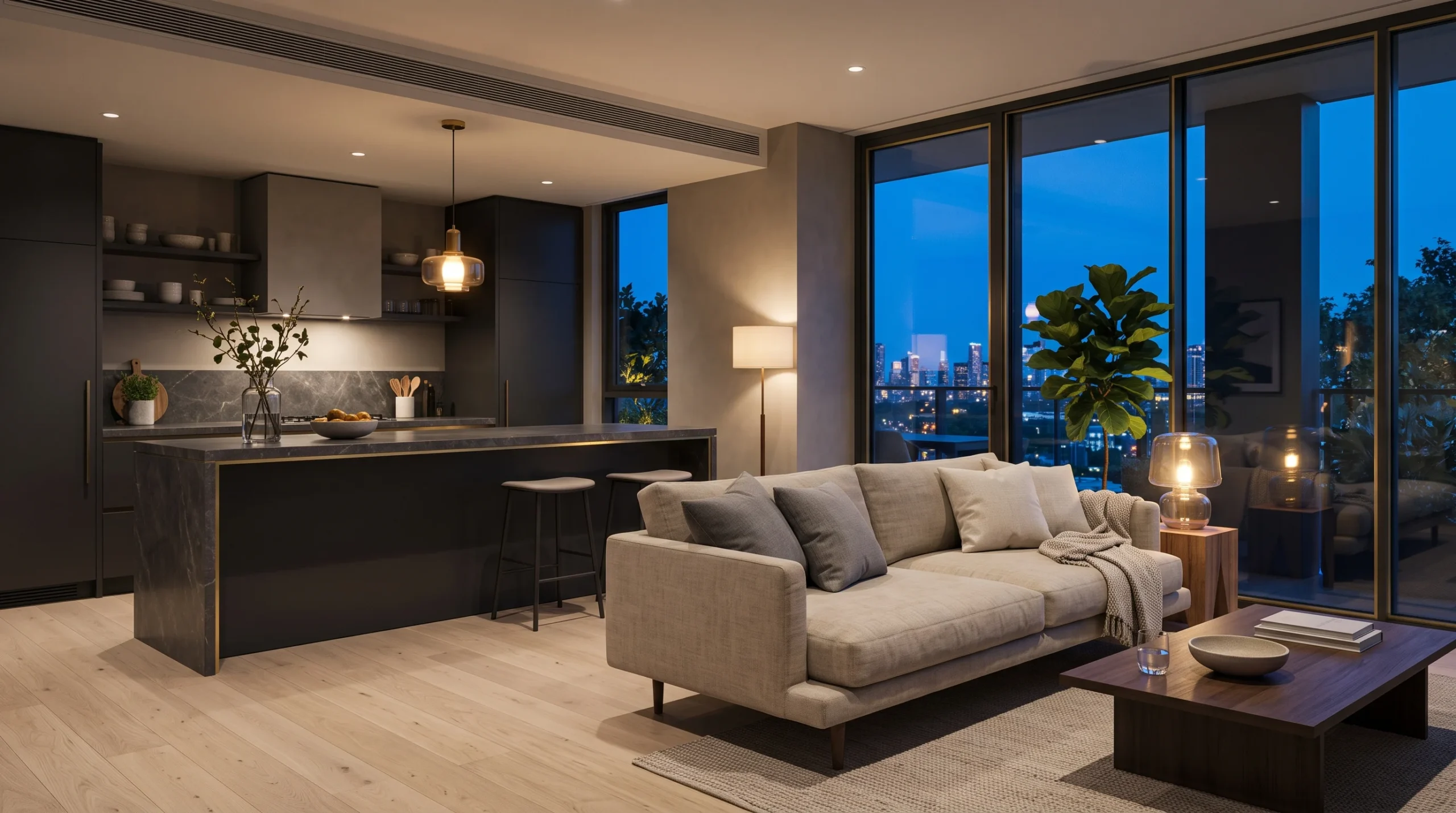
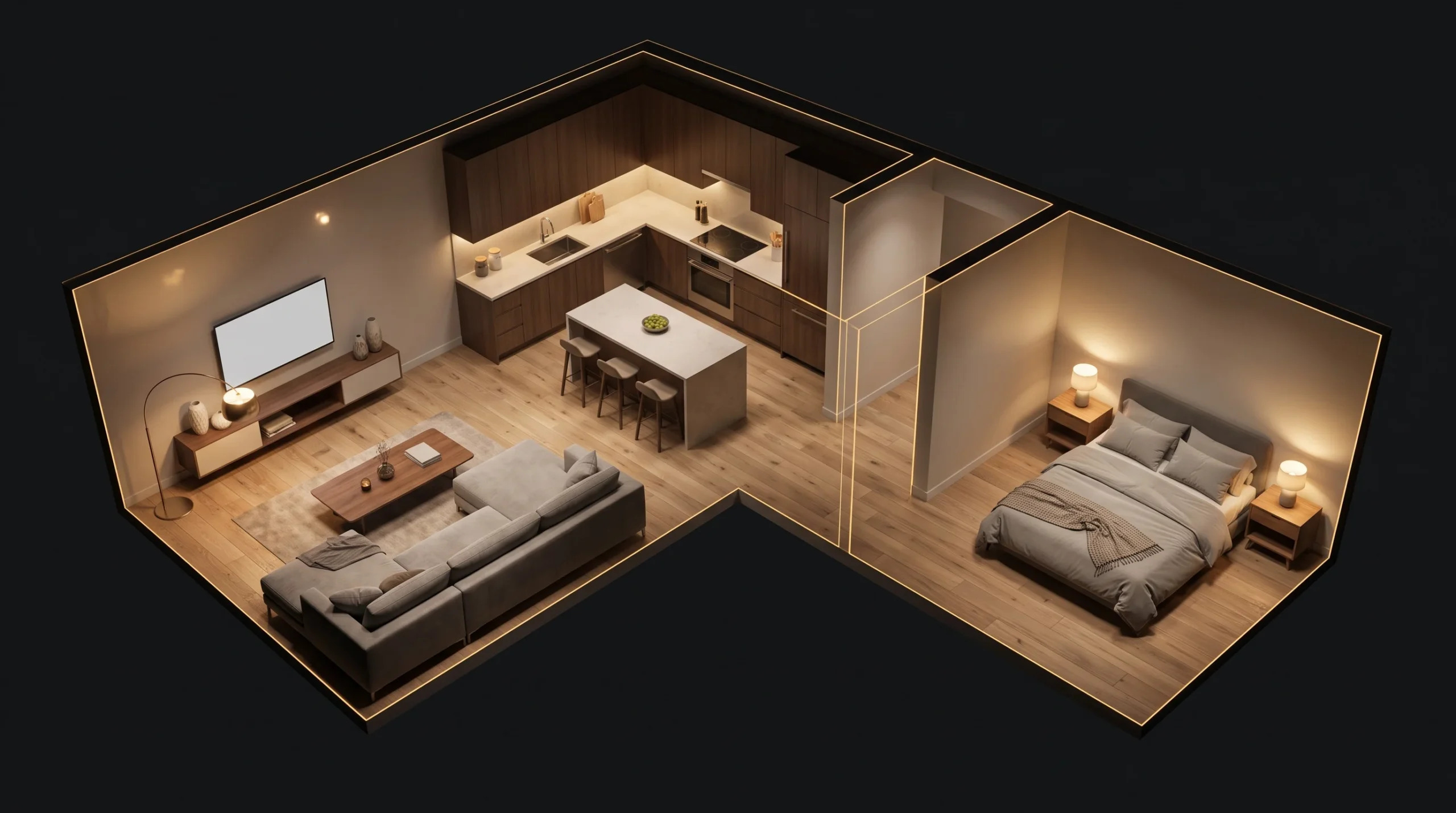
Every comparison you’ll find silently assumes the property is standing, photographable, scannable. For developers, the most valuable marketing window is precisely when it isn’t — off-plan sales, pre-leasing, planning consultations. The fork changes everything: for a built property, all three formats compete, and scan-based tours (Matterport and kin) are on the menu. For an unbuilt one, the scan column vanishes and so does any filmed walkthrough of a finished space that isn’t there. The two formats left — a rendered 360 tour and a 3D animation — both come out of the design files. For a building that doesn’t exist, the argument settles itself: it is no longer scan versus film versus CGI, only which rendered format serves the campaign, or whether you want both.
Virtual tour vs video walkthrough vs animation: the terms, untangled
Half the confusion in this SERP is vocabulary, so, precisely:
- 360 virtual tour — interactive: the viewer stands at fixed points, looks anywhere, and clicks between them. Built from camera scans (existing property) or rendered viewpoints (any property).
- Video walkthrough — linear, filmed: a camera operator walks the real space. Passive viewing, familiar format, existing properties only.
- 3D animation — linear, rendered: a cinematic camera moves through the modeled property, any lighting, any season, built or not. The marketing-film format.
- Free-roam interactive — the game-engine cousin where viewers walk anywhere; genuinely different product, different budget, worth its own conversation.
When a vendor says “3D walkthrough,” ask which of these they mean. Half the industry means the second; the other half means the third.
What the evidence says — with the labels the evidence deserves
The honest state of the data: almost every number in circulation was published by someone selling the format it flatters. Matterport reports listings with 3D tours closing “up to 31% faster” and at “4-9% higher sale price” — but Matterport sells tours, and that post is from February 2020, drawn from MLS data running November 2016 to November 2019. Zillow’s 3D Home statistics (more views, more saves) originate from the portal’s own 2020–21 promotions of its own tool. On the other side, HomeJab — a photography marketplace — published order data showing agents choose video over tours in every category — a preference HomeJab itself attributes to video simply being the format everyone already understands. The closest thing to a neutral counterweight comes from the trade body rather than a vendor, and it is worth having even though it has aged: NAR’s own reporting of its 2021 Generational Trends survey has 67% of buyers saying they want floor plans on listings and 58% saying they want virtual tours. A caution on the newer version of those figures, since you will see them quoted everywhere: the 2025 report publishes its exhibits as images rather than machine-readable text, so every citation of its percentages — including the ones in vendor posts — reaches you second-hand. What has not aged is the supply gap in the same piece: an audit of listing portals found 94% carried no virtual tour and “only 16% of listings included a floor plan” — a listing-technology company’s study, so read it as one too. Our read of the pile: the engagement effects are real and consistent in direction across sources that disagree about everything else; the precise uplift percentages are marketing. Treat them as direction, not forecast — and note what buyers keep asking for that almost nobody supplies, which is a floor plan next to whichever moving format you pick.
Match the format to the funnel, not to the argument
The formats aren’t competitors; they’re stations. Video and animation are reach formats — they autoplay in feeds, travel on Instagram and YouTube, and carry emotion to people who weren’t looking for a property this morning. Tours are qualification formats — the engaged buyer who spends minutes clicking through rooms is telling you something a fifteen-second view count can’t, and listing portals support tour links natively. The practical bundle for a serious campaign is one reach format plus one qualification format — which is why the either/or framing of every vendor comparison misses the way good campaigns actually run.
What each format costs
- Scan-based 360 tour (built only): Momentum works to a starting fee plus “$0.10 per square foot” — its own example puts a 2,500 sq ft property at $550. PricingLink sketches tiers of $400–$650 up to 3,000 sq ft and $650–$1,000+ above, though it labels those “Illustrative 2025 Ranges” and “hypothetical examples”, not observed rates.
- Rendered 360 tour (any property): priced per standing viewpoint, and the published figures spread widely by unit. ArchiCGI lists a 360 virtual tour at $1,600 to $4,000 per project; Trim Render prices one at $350 per room; Render3DQuick charges $2 per square foot. Compare on the unit before you compare on the number.
- Filmed video walkthrough (built only): published rate cards cluster lower than people expect. Alpha Visual lists a regular walkthrough at $299, a luxury 4K one at $599 and a premium 4K film at $999 — with drone video a separate $249.99 line, which is why quoting “cinematic or drone” as one band overstates both. Productions with talent, twilight scheduling and heavier post run into the low thousands.
- 3D animation (any property): Render3DQuick starts at $2,500 a minute; Trim Render’s $75 a second works out near $4,500 a minute; Omega Render puts the market average at “$8,000 per minute of animation”. Cinematic work runs well past all three.
Note the asymmetry worth exploiting: once a property is modeled for animation, rendered tour viewpoints come from the same model at incremental cost — the two CGI formats amortize each other in a way filmed formats never can.
The honest defaults
Built property, volume listings: filmed video plus a scan tour — cheap, fast, familiar. Built flagship: add animation if the campaign justifies cinema. Unbuilt property: the rendered pair — animation for reach, rendered tour for the buyer who wants to stand in the unit — sequenced off one model. That last lane is where we live, and it’s the one no scan vendor can follow you into; our walkthrough and tour production covers both rendered formats end to end.